

Hello my friends,
This past weekend, I sat down to work on a fantasy manuscript I’ve been noodling on. It’s not my main project (the Appalachian fantasy-horror with coal demons and bisexual love triangles), but one that I’ve been excited to dip my toes into and start fleshing out on the side.
And yet, despite my excitement, getting through the second chapter felt like pulling teeth. Everything was just so… dry. How could a fantasy novel about the realms of gods bleeding into our own, femme fatale assassins magically bound to serve cruel masters, and childhood friends being reunited as enemies on opposite sides of a war between divines feel like such a nothingburger?
Rereading the first ten pages or so, I realized the mistake.
There was some decently competent prose in there, but the protagonist was just present for the events unfolding in the narrative around him. He didn’t have clearly defined wants or needs or obstacles in his way. He was just sort of there.
Okay, problem diagnosed. And in theory, I know how to fix it. I’ve got a degree in literature! I write a lot! I’ve taught myself web development and SaaS economics, so surely I can teach myself how to fix this problem in my prose, right?
Well, probably. With time and some concerted effort, I can definitely think through this problem and reapproach my manuscript with a fresh approach.
But as I journaled about my manuscript and started fleshing out ideas about what kinds of misbeliefs and wants would fuel my protagonist, I also realized that it was illogical of me to expect myself to be able to make consistent, linear progress on my craft when the time and attention I (can) devote to it is so limited.
Indulge me in a gym metaphor for a moment. When you’re trying to build strength, you have to put in consistent reps. You have to target the muscle group at a regular cadence, using proper form and technique, and challenge yourself to progressively overload your muscles by adding weight or reps at regular intervals. The process is easily observed in muscle building, but the general principles are fairly universal for growth in other areas of life. Including your goddamn creativity.
When the bulk of my mental energy goes into my day job and trying to fend off the surplus of notifications and temptation to sit and scroll that compete for my attention, my creative writing ends up getting table scraps instead of an entree. How can I expect to reclaim the creative parts of my life and bulk them up when they’re not being fed enough to reach their protein goals? Weird mixed metaphor, but you get my point (I hope… pretend you do).
I think part of what has been tripping me up is a pernicious flavor of the Halo Effect mixed with the Dunning-Kruger effect.
In describing the Halo Effect, the folks at Decision Lab write,
The halo effect is a perception error that distorts how we evaluate people and things. It causes us to generalize from a single positive trait or characteristic to assume the presence of other positive qualities, resulting in biased judgments.
For me, I think I’ve been assuming that because I’ve been able to independently think my way around obstacles and have had past successes in my writing, I can more easily overcome similar challenges in other aspects of my writing without engaging in concerted practice. To describe myself as if I’m the protagonist in my manuscript: What I want is to improve my writing, but I have the internal misbelief that because I’m a writer, I should be able to master any and all writing challenges regardless of the disparity of the nature of those challenges.
But the Dunning-Kruger Effect also comes into play. Dunning-Kruger is one of those cognitive biases that everyone (AKA me specifically) likes to think they’re above– likes to think they can’t possibly be affected by, because we like to think our worldviews are entirely accurate. While the concept has come under scrutiny and been reevaluated in recent years, it’s still a phenomenon that plays out across domains and individuals pretty consistently. We can define it as follows:
The Dunning-Kruger effect occurs when a person’s lack of knowledge and skill in a certain area causes them to overestimate their own competence. By contrast, this effect also drives those who excel in a given area to think the task is simple for everyone, leading them to underestimate their abilities.
The Halo Effect has me feeling like I should excel in all areas of writing because of my successes in other areas. And because I have a foundation in many aspects of writing, I go all Dunning-Kruger and overestimate my capabilities in other areas of writing.
Wow. I can’t believe that I, a human, am subject to the norms of human psychology. Rude
In her newsletter, poet Wendy Pratt discusses the importance of going back to the Beginner’s Mindset as a means of getting unstuck and avoiding cutting yourself off from opportunities to grow. As she so eloquently writes,
To approach anything with a beginner’s mind means looking at things with freshness and openness. It’s a way of approaching life, and creativity, without the clutter of what you should be doing, what you are expected to do and even what you have learned to do. You might have been writing for a long time, and if you have then you’ll be used to writing in a certain way; you’ll have learned a certain set of skills and a style of writing which suits you, you might have read books on creativity, attended courses and retreats, and you might even be in a groove where you read the same style of books, without moving too far away from your comfort zone.
So, I decided that while I will continue to be a bit autodidactic in my approach to writing, I’ll also invest the time, energy, and money to go back to the basics and take a more structured approach. I’ve submitted an application to join the Gotham Writers Workshop's Creative Writing 101 course starting in Mid-April and am challenging myself to approach it with a beginner’s mindset. My goal for the workshop is, broadly speaking, to get unstuck. To be a bit more precise, though, it’s to allow myself to come bcak to my writing with the curiosity and willingness to stumble that I had as an undergrad, when I could sit down at a computer and crank out a short story without caring if it’s crap; I hope to revisit the basics that I’ve haughtily assumed I’ve mastered with fresh eyes and an open mind, pushing my ego out of the way and inviting new and fresh perspectives into my writing practice.
I’ll let you know how it goes.
Worth Fighting For
Periodically, I like to draw attention to the people and organizations fighting the good fight to champion a world of cultural richness instead of scroll-inducing shallowness.
Today, I’d like to give a shout-out to a nonprofit from my home state of Kentucky, Sarabande Books.

Sarabande is one of the few publishers based out of Kentucky, and they maintain an exceptionally high bar of quality in the work that they publish. Not only does Sarabande champion a distinct sense of taste in the poetry, short fiction, and essays that they publish, but they also invest deeply in cultivating the arts and literature scene more broadly.
In their own words,
“With nearly three hundred titles in print, we have earned a dedicated readership and a national reputation as a publisher of diverse forms and innovative voices. Through our free arts programming, we are proud to invest in emerging writers and serve as an educational resource locally and nationally.”
I’ve known about Sarabande for a while– their main office in Louisville, Kentucky, is quite close to where I did my undergrad, and they were generous enough to send speakers to several of my upper-level English courses.
But there was a moment last year when I took my support for Sarabande to the next level, opting to make a monthly financial contribution instead of merely offering them verbal praise. Under the Orange Shitstain’s administration, the National Endowment for the Arts (NEA) levied an ultimatum to publishers and nonprofits receiving NEA funding that prohibited the publication and promotion of “trans, nonbinary, or gender fluid authors.” Sarabande refused, and the NEA rescinded its funding.
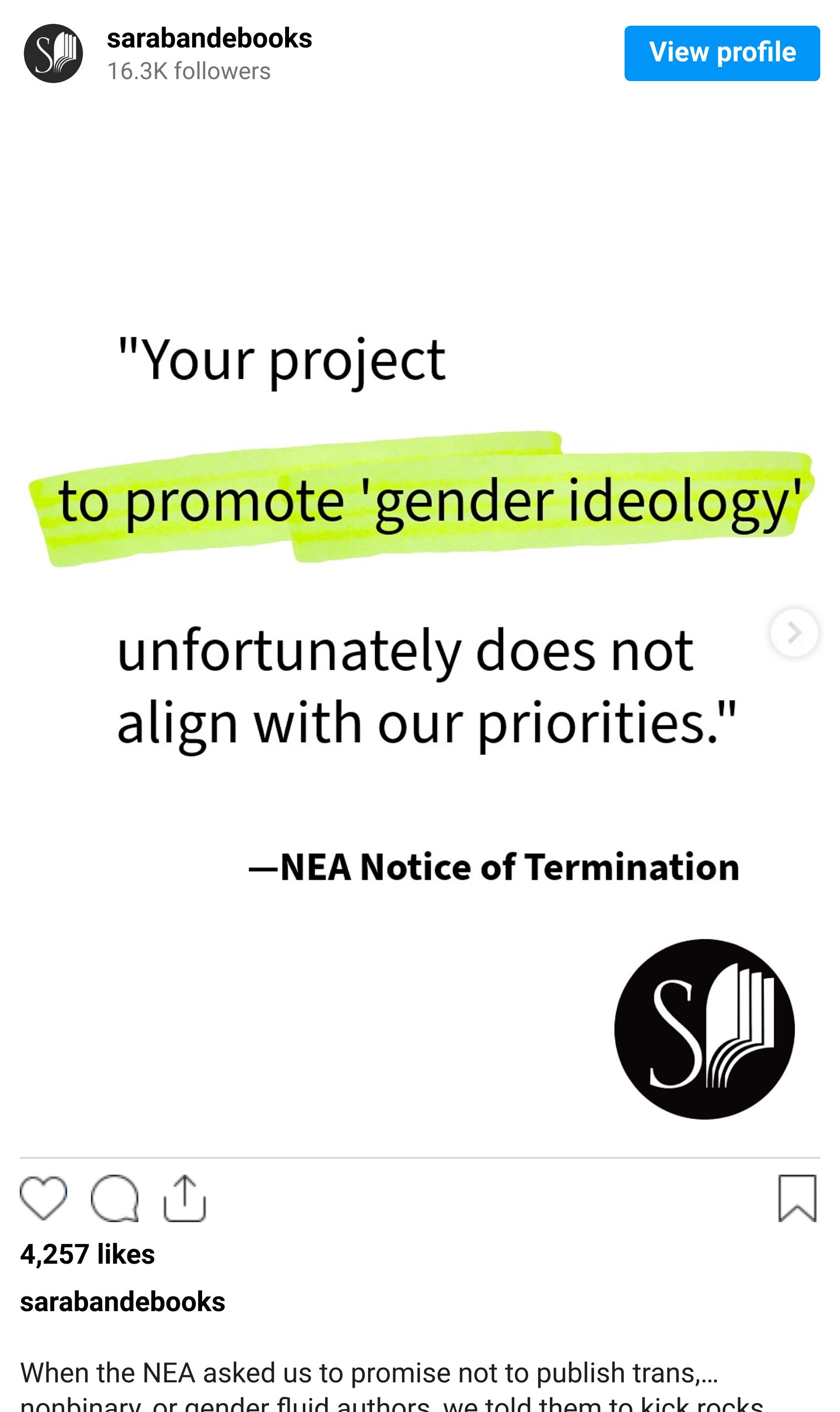
While I can’t make up for the grant money lost on my own, I can still help out. I, too, would like to tell the NEA and the current administration to kick rocks (among other things I won’t publicly document). So, I make a monthly contribution of $20 to Sarabande, and would encourage you to do the same.
Your Turn
Are You Creatively Ego Lifting?

Art by Blake Reichenbach
I’ll wrap up this week with a prompt: Where is your ego getting in the way of your growth?
We all have areas where our past successes make us too proud to return to the fundamentals. This week, find one creative pursuit where you've been expecting mastery without putting in the basic reps. Give yourself permission to be a beginner again. Strip it down to the studs, embrace the awkwardness of not knowing, and see what happens when you stop expecting perfection.
I'd love to hear what you're working on—hit reply and let me know.
And finally, a quick favor: growing this newsletter is a lot like building a creative habit—it happens one rep at a time. If you found today's essay helpful, please consider forwarding it to a friend or sharing it on your favorite social platform (ya know, instead of that endless scrolling we’re all trying to get away from).
Until next time,

Irreverent. Creative. Human.